How AI Automation Is Transforming Small Business Operations in 2026

How AI Automation Is Transforming Small Business Operations in 2026
⚡ Quick Answer: What You Need to Know
- 89% of small businesses now use AI to automate repetitive tasks and improve efficiency (Intuit & ICIC, 2026).
- AI automation tools can deliver a 25% productivity increase when properly implemented (McKinsey, 2025).
- The highest-ROI areas for small businesses are customer service, marketing automation, and workflow management.
- You don't need a large budget — many AI tools start free or under $50/month and integrate with tools you already use.
- The key to success is starting with one high-impact automation, measuring results, then expanding systematically.
If you've been watching the business landscape over the past two years, one trend is impossible to ignore: artificial intelligence has moved from a buzzword reserved for enterprise boardrooms to a practical, affordable toolkit that small businesses are using every single day. The question is no longer whether AI can help your business — the data is overwhelming on that point. The real question is where to start and which tools actually deliver results.
In 2026, small business owners face a unique opportunity. AI automation tools have matured significantly, pricing has dropped, and the learning curve has flattened. A freelance consultant, a local service business, or a growing e-commerce store can now automate tasks that once required a full-time employee — from responding to customer inquiries to generating marketing content to managing their entire sales pipeline. The businesses that understand this shift are pulling ahead, while those that ignore it risk falling behind.
This guide breaks down the most impactful AI automation opportunities for small businesses in 2026, backed by current data and real-world examples. Whether you're just starting your AI journey or looking to expand what you've already built, you'll find actionable insights you can apply immediately.
1The State of AI Adoption in Small Business: 2026 Data

The numbers tell a compelling story. According to a 2026 report by Intuit and the Initiative for a Competitive Inner City (ICIC), 89% of small businesses are now leveraging AI, primarily for automating repetitive tasks and improving operational efficiency. That's a dramatic shift from just two years ago, when adoption hovered around 40%. A QuickBooks survey reinforces this, finding that 68% of U.S. small businesses now use AI regularly — up sharply from 48% in mid-2024.
What's driving this acceleration? Three factors stand out. First, the tools themselves have become dramatically easier to use — no coding or technical background required. Second, pricing has dropped to the point where even a solo entrepreneur can afford meaningful automation. Third, and perhaps most importantly, early adopters have demonstrated real, measurable results that have convinced skeptics to take the plunge.
According to a LinkedIn report released in January 2026, AI has become a "strategic asset" for small businesses, with 57% of small business owners believing AI will improve their daily work lives. The same report noted a 69% increase in people adding "founder" to their LinkedIn profiles — a signal that AI is lowering the barriers to entrepreneurship by making it possible to operate leaner and smarter than ever before.
"AI has moved from a tool to a strategic asset for small businesses aiming to stay resilient and grow in 2026. By adopting AI, businesses can streamline operations, reduce costs, and accelerate decision-making, creating space for innovation and relationship-building." — Sharat Raghavan, Economist & Director of Research, LinkedIn
2The 5 Highest-ROI AI Automation Areas for Small Businesses

Not all AI automation delivers equal value. Based on current research and practitioner experience, five areas consistently generate the strongest return on investment for small businesses.
Customer Service and Response Automation
Customer service is where many small businesses feel the most pressure — and where AI delivers some of the fastest wins. Chatbots and AI-powered response systems can handle routine inquiries around the clock, freeing your team to focus on complex issues that genuinely require human judgment. According to a 2026 survey, 95% of SMBs using AI for customer service report improved response quality, and over 92% experience faster turnaround times. By 2026's end, 80% of small businesses plan to integrate AI chatbots into their customer support strategies.
Tools like ChatGPT-powered assistants, integrated directly into your website or messaging platform, can answer FAQs, qualify leads, and even schedule appointments — all without human intervention. The key is training these tools on your specific business context so responses feel natural and accurate.
Marketing Automation and Content Creation
Marketing is another area where AI has proven its value decisively. A 2025 SAS study found that over 80% of marketing teams see ROI from generative AI tools. High-performing marketers are nearly three times as likely to have fully implemented AI in their operations compared to low performers (Salesforce, 2025). For small businesses, this translates to being able to produce consistent, high-quality content — blog posts, social media updates, email campaigns, ad copy — at a fraction of the previous cost and time.
Tools like Jasper for long-form content, Canva's AI design features for visual assets, and AI-powered email platforms for personalized campaigns have become standard in the modern small business marketing stack. The businesses seeing the best results are those that use AI to amplify their authentic voice rather than replace it entirely.
Workflow and Process Automation
Zapier remains the gold standard for no-code workflow automation, connecting over 7,000 apps and enabling small businesses to automate multi-step processes without writing a single line of code. A typical example: when a new lead fills out a form on your website, Zapier can automatically add them to your CRM, send a personalized welcome email, create a task for your sales team, and notify you via Slack — all in seconds. IT teams using AI automation cut out upwards of 30 minutes per support ticket (Zapier, 2026), and similar time savings apply across all business functions.
Financial Management and Invoicing
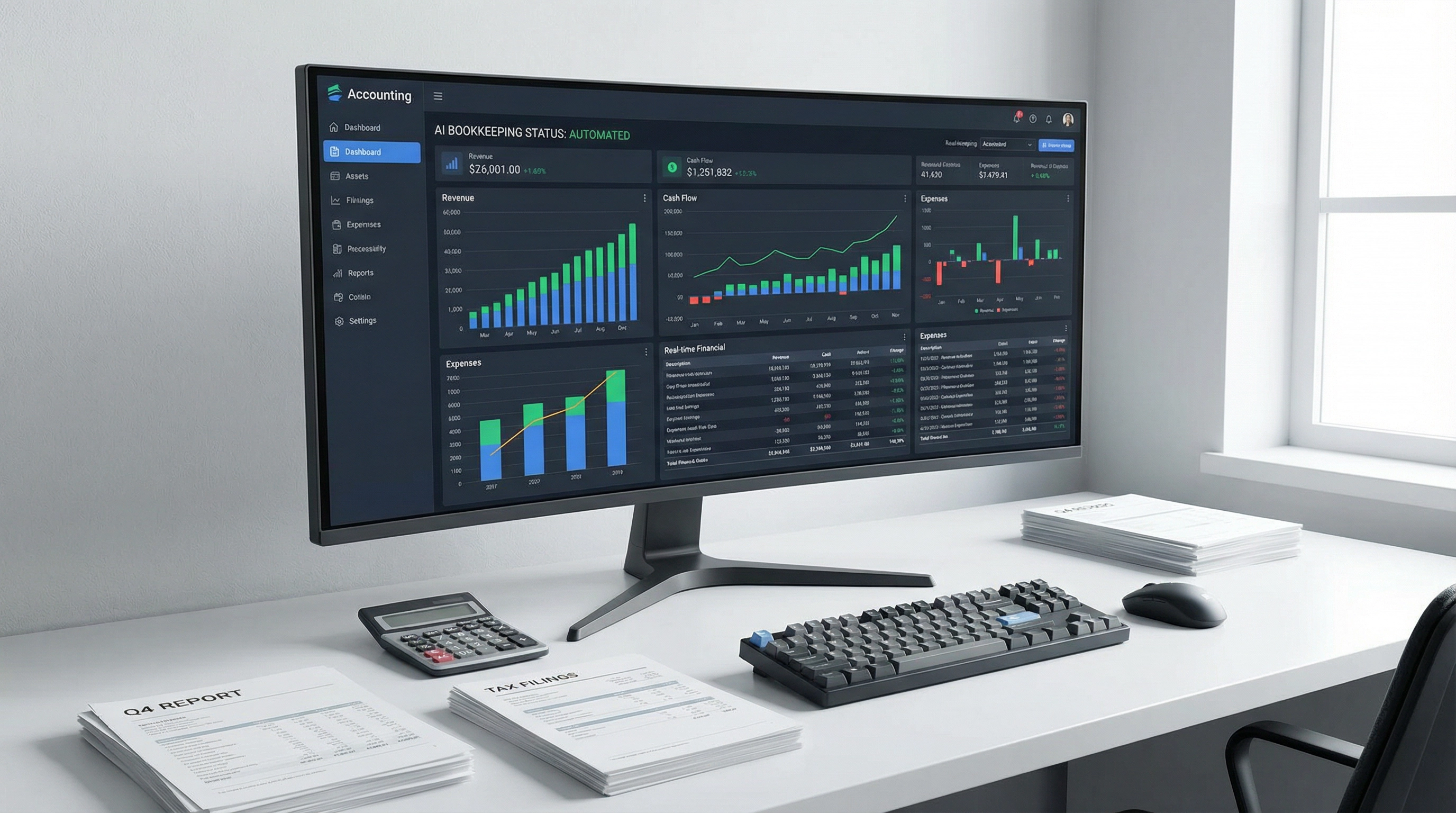
QuickBooks and similar AI-powered accounting tools have transformed financial management for small businesses. Automatic expense categorization, invoice generation, payment reminders, and cash flow forecasting — tasks that once consumed hours of a business owner's week — can now run largely on autopilot. This is particularly valuable for service businesses and freelancers who need to maintain professional financial operations without a dedicated accounting team.
Sales Pipeline and CRM Management
The global AI in CRM market reached $14.9 billion in 2025, growing at 35.2% annually — a clear indicator of how much value businesses are finding in AI-powered customer relationship management. AI-enhanced CRM systems can score leads automatically, predict which prospects are most likely to convert, surface the optimal time to follow up, and even draft personalized outreach messages. For small businesses, this means competing with larger organizations that have dedicated sales teams, without the overhead.
3AI Automation Tool Comparison: What Works for Small Businesses

With hundreds of AI tools on the market, choosing the right ones can feel overwhelming. The table below provides an honest comparison of the most relevant tools for small business operations, organized by primary use case.
| Tool / Platform | Primary Use Case | Best For | Starting Price | Ease of Use |
|---|---|---|---|---|
| ChatGPT / GPT-4 | Content creation, customer Q&A, drafting | Solo operators, content teams | Free / $20/mo | ★★★★★ |
| Zapier | Workflow automation, app integration | Any business with multiple tools | Free / $19.99/mo | ★★★★☆ |
| Canva AI | Visual content, social media design | Marketing teams, solopreneurs | Free / $15/mo | ★★★★★ |
| Jasper | Long-form content, ad copy, SEO | Content marketers, agencies | $49/mo | ★★★★☆ |
| QuickBooks AI | Invoicing, expense tracking, forecasting | Service businesses, freelancers | $30/mo | ★★★★☆ |
| Slack AI | Team communication, meeting summaries | Teams of 3+ | Free / $7.25/mo | ★★★★★ |
| MOLA | All-in-one: CRM, marketing, website, automation | SMBs wanting a unified platform | Contact for pricing | ★★★★☆ |
The right choice depends heavily on your current tech stack, team size, and primary pain points. Many small businesses find that starting with a workflow automation tool like Zapier to connect existing apps delivers immediate value, while simultaneously exploring an all-in-one platform for longer-term consolidation. For businesses that want to manage CRM, marketing automation, and client communication in a single place, platforms like MOLA offer an integrated approach that can reduce the complexity of managing multiple separate subscriptions.
"The new competitive edge is upskilling on AI literacy, which is emerging as a driving force for small businesses. To win in 2026, SMBs should upskill teams and leverage AI to make technology work for them, while they focus on earning trust and strengthening relationships." — Sharat Raghavan, LinkedIn
4Real-World Implementation: A Step-by-Step Approach

One of the most common mistakes small businesses make when adopting AI is trying to automate everything at once. This leads to overwhelm, poor implementation, and ultimately abandonment of tools that could genuinely help. A more effective approach is systematic and incremental.
Step 1: Audit Your Time Drains
Before choosing any tool, spend one week tracking where your time actually goes. Most small business owners are surprised to discover that 30-40% of their week is consumed by tasks that are highly repetitive: answering the same customer questions, manually following up with leads, copying data between systems, creating similar reports. These are your automation targets. Document the top five time-consuming tasks and estimate the weekly hours each consumes.
Step 2: Start with One High-Impact Automation
Resist the temptation to overhaul everything simultaneously. Choose the single automation that would free up the most time or generate the most revenue if implemented well. For most service businesses, this is either lead follow-up automation or customer onboarding. For product businesses, it's often inventory management or order fulfillment notifications. Implement it thoroughly, measure the results, and let the success build momentum for the next initiative.
Step 3: Connect Your Tools
Most small businesses already use 5-10 different software tools. The problem is that these tools rarely talk to each other, creating data silos and manual transfer work. Zapier or Make (formerly Integromat) can bridge these gaps without any coding. A simple automation that syncs your contact form submissions directly into your CRM and triggers a personalized email sequence can save hours per week and ensure no lead falls through the cracks.
Step 4: Automate Your Marketing Content Pipeline
Content marketing is one of the highest-leverage activities for small businesses, but it's also one of the most time-consuming. AI writing assistants like ChatGPT or Jasper can dramatically accelerate content production — drafting blog posts, social media captions, email newsletters, and ad copy in a fraction of the time. Pair these with Canva's AI design tools for visuals, and you have a near-complete content pipeline. The key is to always review and add your authentic voice before publishing; AI provides the structure and draft, you provide the expertise and personality.
Step 5: Implement AI-Powered CRM and Follow-Up
Once your content and workflow automations are running smoothly, the next frontier is your sales process. An AI-enhanced CRM can automatically score incoming leads based on their behavior, send personalized follow-up sequences based on where a prospect is in the buying journey, and alert your team when a high-value lead is showing buying signals. For businesses managing dozens or hundreds of relationships simultaneously, this kind of intelligent automation is the difference between a chaotic sales process and a predictable revenue engine. Platforms that combine CRM with marketing automation — such as MOLA — allow you to manage the entire customer journey from a single dashboard, reducing the friction of switching between multiple tools.
5Common Pitfalls and How to Avoid Them
Despite the clear benefits, many small businesses struggle to realize the full potential of AI automation. Understanding the most common pitfalls can save you significant time and money.
Over-Automating Before You've Validated the Process
Automating a broken process just makes it break faster. Before you automate any workflow, make sure the underlying process is sound. If your lead follow-up sequence isn't converting, adding AI to it won't fix the fundamental problem — it will just send bad messages faster. Always validate and optimize your processes manually before automating them.
Neglecting the Human Touch
According to the LinkedIn 2026 report, nearly 75% of small business owners agree that "audiences today don't just take information at face value — they gut-check it with people they trust." AI can handle volume and consistency, but your customers still want to know there's a real human behind the business. The most effective approach is to use AI for the routine and repetitive, while reserving human interaction for the moments that matter most: complex questions, high-value relationships, and sensitive situations.
Ignoring Data Quality
AI is only as good as the data it works with. If your CRM is full of duplicate contacts, outdated information, or inconsistent formatting, your AI-powered automations will produce poor results. Before implementing any AI tool, invest time in cleaning and organizing your data. This foundational work pays dividends across every automation you build on top of it.
Failing to Train Your Team
A 2026 Zapier survey found that half of all employees want more AI training, yet only 1% of businesses believe they've reached AI maturity. The gap between tool adoption and effective use is largely a training problem. When you implement a new AI tool, build in dedicated time for your team to learn it, experiment with it, and develop best practices. The businesses seeing the strongest results from AI are those that treat it as an ongoing capability to develop, not a one-time software purchase.
6Measuring ROI: How to Know If Your AI Automation Is Working
One of the most common frustrations with AI adoption is difficulty measuring its impact. According to Zapier's 2026 research, 92% of enterprise leaders say it's either difficult or only partially manageable to prove AI ROI at scale. For small businesses, however, the measurement challenge is actually more manageable because the scale is smaller and the impact more direct.
The most reliable approach is to establish clear baselines before implementing any automation. How many hours per week does your team currently spend on the task you're automating? What is your current lead response time? What is your email open rate? Once you have these baselines, measuring improvement becomes straightforward. Track the same metrics monthly and compare against your pre-automation baseline.
Beyond time savings, look for downstream business impacts: increased lead conversion rates, higher customer satisfaction scores, more consistent content publication, faster invoice payment cycles. These second-order effects are often where the most significant business value accumulates. A business that responds to leads within five minutes instead of five hours, for example, can see conversion rates improve by 50-100% — a result that far exceeds the cost of the automation tool that made it possible.
"SMBs make up over 90% of all businesses and employ half the global workforce, so scaling AI adoption could have a massive economic impact. The businesses that invest in AI literacy and implementation today are building a competitive advantage that will compound over the next several years." — Sharat Raghavan, LinkedIn Research
7Getting Started: Your 30-Day AI Automation Action Plan
Knowing what to do and actually doing it are two different things. Here is a concrete 30-day plan that any small business can follow to begin realizing the benefits of AI automation without overwhelm.
- Days 1-3: Audit your top five time-consuming tasks. Document the steps, time required, and frequency of each.
- Days 4-7: Research and sign up for free trials of two or three tools relevant to your highest-priority automation target. ChatGPT, Zapier, and Canva all offer free tiers that are sufficient for initial testing.
- Days 8-14: Implement your first automation. Keep it simple — a single trigger and a single action. Test it thoroughly before relying on it.
- Days 15-21: Measure the impact. Track time saved, errors reduced, and any downstream business metrics affected. Document what's working and what needs adjustment.
- Days 22-30: Expand or refine. If the first automation is working, either optimize it further or begin planning your second automation. If it's not working as expected, diagnose the issue before moving on.
For businesses that want a more integrated starting point — combining CRM, marketing automation, and client management in one place — exploring an all-in-one platform early in the process can simplify the technology stack considerably. MOLA, for example, is designed specifically for small and mid-sized businesses that want to manage their entire customer journey without stitching together a dozen separate tools. Whether you choose a best-of-breed approach with individual tools or an integrated platform, the most important step is simply to begin.
Frequently Asked Questions
The cost varies widely depending on the tools you choose and the scale of automation. Many powerful tools — including ChatGPT's free tier, Zapier's free plan (up to 100 tasks/month), and Canva's free design tools — cost nothing to start. Paid plans for most small business AI tools range from $15 to $100 per month. A realistic budget for a comprehensive AI automation stack covering content, workflow, and CRM is $100-300/month, which is typically offset many times over by the time savings and revenue gains generated.
No. The vast majority of AI tools designed for small businesses require no coding or technical background. Tools like Zapier use a visual, drag-and-drop interface to build automations. ChatGPT and Jasper work through natural language — you simply describe what you want. Canva's AI features are integrated into a design tool that millions of non-designers use daily. If you can use a smartphone, you can use these tools.
For most small businesses, AI automation replaces tasks, not people. The goal is to free your team from repetitive, low-value work so they can focus on higher-value activities — building relationships, solving complex problems, and growing the business. In practice, most small businesses that implement AI automation find they can do more with the same team rather than needing to reduce headcount. The 71% of Americans who fear AI-caused job loss (Reuters, 2025) are largely concerned about large-scale industrial automation, not the kind of business process automation most small businesses implement.
Simple automations — like automatically responding to new leads or scheduling social media posts — can deliver measurable time savings within the first week of implementation. More complex automations, like a full AI-powered sales pipeline or a content marketing system, typically take 30-60 days to set up properly and another 30-60 days to optimize. Most small businesses report seeing clear ROI within 90 days of their first meaningful AI implementation.
The most common mistake is trying to automate too much too quickly. Businesses that attempt to overhaul their entire operations at once often end up with poorly configured automations that create more problems than they solve. The most successful implementations start small — one automation, thoroughly tested and measured — and expand systematically from there. The second most common mistake is automating a broken process rather than fixing the process first.
Data security is a legitimate concern and one you should evaluate carefully for each tool you adopt. Reputable AI tools — including ChatGPT Enterprise, Zapier, and most major CRM platforms — offer enterprise-grade security, data encryption, and clear privacy policies. Before adopting any tool, review its data handling practices, particularly if you handle sensitive customer information. For businesses in regulated industries (healthcare, finance, legal), additional due diligence is required to ensure compliance with relevant regulations.
This is one of the most important strategic decisions in building your AI stack. Best-of-breed tools (using the best individual tool for each function) offer maximum flexibility and often the most advanced features in each category. All-in-one platforms (like MOLA, which combines CRM, marketing automation, and website tools) offer simplicity, reduced integration headaches, and a unified view of your customer data. For most small businesses with limited technical resources, starting with an all-in-one platform and adding specialized tools as specific needs emerge is the more practical approach.
✅ Key Takeaways
- AI adoption among small businesses has reached a tipping point — 89% are now using AI for operations, and the gap between adopters and non-adopters is widening.
- The five highest-ROI automation areas are customer service, marketing content, workflow integration, financial management, and CRM/sales pipeline.
- Start with one high-impact automation, measure the results, then expand systematically — avoid the temptation to overhaul everything at once.
- Most AI tools are accessible to non-technical users and cost less than $100/month to start, with free tiers available for initial testing.
- AI amplifies human capability — it handles the repetitive so your team can focus on the relational and strategic work that drives real business growth.
- Measure ROI by establishing clear baselines before implementation and tracking time saved, conversion improvements, and downstream business metrics.
Conclusion
The AI automation revolution isn't coming — it's already here, and small businesses that embrace it thoughtfully are gaining meaningful competitive advantages. The data is clear: 89% of small businesses are using AI, productivity gains of 25% or more are achievable, and the tools to get there are more accessible than ever. The question isn't whether to adopt AI automation, but how to do it in a way that genuinely serves your business goals.
The most important thing to remember is that AI works best as an amplifier of your existing strengths, not a replacement for them. Your expertise, your relationships, and your understanding of your customers are irreplaceable. AI handles the volume, the consistency, and the repetition — freeing you to focus on what only you can do.
Start small, measure carefully, and build systematically. Whether you begin with a simple Zapier automation, a ChatGPT-powered content workflow, or an integrated platform that manages your entire customer journey, the businesses that start today will be the ones leading their industries tomorrow.
Ready to Streamline Your Business Operations with AI?
MOLA brings together CRM, marketing automation, website management, and client communication in one platform — built specifically for small and mid-sized businesses that want to grow smarter, not just harder.
Explore MOLA's AI-Powered Platform →


